


Six hundred fascia scientists, hands-on practitioners, and movement therapists from around the world converged in New Orleans this summer for the 7th International Fascia Research Congress. Researchers, clinicians, and movement teachers filled lecture halls and movement rooms alike—listening, questioning, experimenting, and moving together.
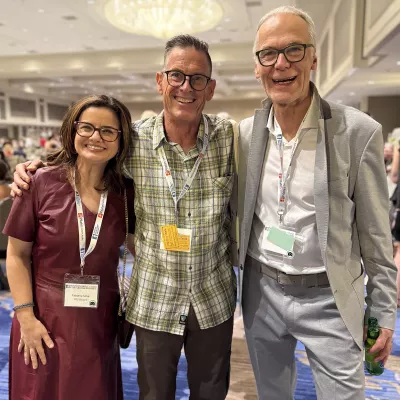
For practitioners who couldn’t be there, here’s a glimpse of how science and practice found common ground.
Cross-Pollination and Connection
“Become like fascia,” Robert Schleip, PhD, told me when I caught him for a conversation between sessions, “not isolated or protective but connecting richly across boundaries.”
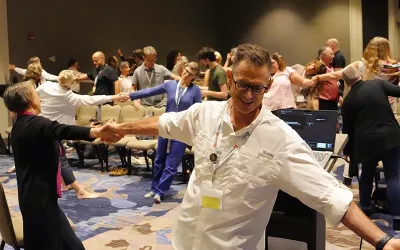
That summed up the mood of the congress. Each morning began with movement sessions—everything from qigong to yin yoga to lively experimental warm-ups that reminded us why fascia loves to move.
Then came packed keynotes and parallel tracks of lectures, hands-on labs, and poster talks. Between sessions, conversations spilled into hallways, cafés, and the New Orleans streets, where small groups compared notes over beignets or late-night jazz. Those informal exchanges—including a dedicated room for informal session exchanges—often felt just as valuable as the formal presentations.
Science That Moves
One of the biggest buzzes centered on researcher Keith Baar (from the University of California, Davis) and his work on tendon and collagen adaptation. Baar’s lab is finding that short, low-load isometric holds—about 10 seconds each, for a total of around 10 minutes a day—optimize collagen synthesis. More isn’t necessarily better; in fact, overdoing it can slow recovery. For bodyworkers and movement educators, there’s a clear takeaway: tissues thrive on measured challenge, not maximal effort.
Schleip called Baar’s data “a game changer for hypermobility and injury recovery” and hinted that future studies may explore how those findings pair with hands-on methods. That kind of back-and-forth between lab and table was a hallmark of the week.
Fascia, Inflammation, and Hands-On Work
At the close of the congress, I taught a three-hour postconference workshop on inflammation and fascia—sharing hands-on approaches for calming and modulating inflammatory responses. After four long days of slides and science, people were eager to get their hands moving again. The room filled quickly, and even after days of learning, the energy was high; it felt like the perfect moment to bridge research and practice.
Other highlights included talks on fascia’s neuro-immune roles, new AI-assisted ultrasound imaging, and the vagus nerve’s deep anatomical and physiological ties to connective tissue. The views on fascia itself were as varied as the participants, ranging from presentations about fascia’s physical properties to neurological implications and autonomic links to discussions about its role as an energetic interconnector. Linking these diverse views was widespread agreement that fascia is more than a structure—it’s a system of communication linking body, brain, sensation, and emotion.
A New Generation of Organizers
This year’s congress was organized entirely by women— Kyra De Coninck, Jo Phee, Fabiana Silva (Fascia Research Society president), and Tina Wang—and their collaborative spirit was unmistakable. Rather than separating clinicians from scientists, they designed an “eye-level” program where both learned from each other. As Schleip put it, “We used to be about being right and ‘science first.’ Now it’s science and clinicians together.”
Linking these diverse views was widespread agreement that fascia is more than a structure—it’s a system of communication linking body, brain, sensation, and emotion.
That inclusive spirit extended beyond the conference center. New Orleans itself—the music, the food, the street energy—kept reminding us that learning doesn’t stop when the projector turns off. Whether it was a late-night gumbo conversation about inflammation or a breakfast chat about vagal tone, the city seemed to invite connection.
From Theory to Table
Across the sessions, one theme kept resurfacing: curiosity. Researchers wanted to understand what therapists feel under their hands; practitioners wanted to grasp what’s happening at the cellular level. That mutual curiosity made for some unforgettable hallway moments—and for a growing sense that our collective learning is accelerating.
The next Fascia Research Congress will be about three years from now (location TBD). Wherever it lands, the mix of science, art, and embodied experience will no doubt keep evolving. Like fascia itself, this network keeps adapting, strengthening, and finding new ways to connect.
Resources
Available at fasciacongress.org and advanced-trainings.com.